
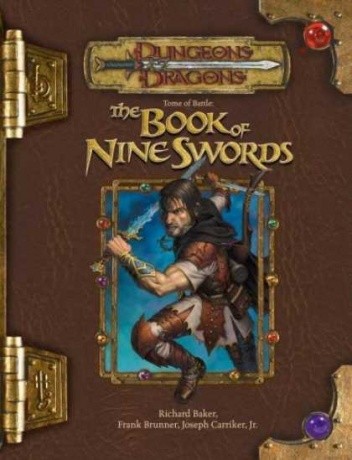
Tome of Battle: The Book of Nine Swords
Tome of Battle: The Book of Nine Swords describes a system of special combat "spells" known as the Sublime Way, the Nine Disciplines, or blade magic. Here are some of the salient terms and facts you will need to be familiar with as you peruse this book. Martial Adept: A character with one or more levels in the crusader, swordsage, or warblade class is known as a martial adept. Maneuver: A maneuver is a specific, one-shot effect that a martial adept initiates. In this way, a maneuver is functionally similar to a spell. However, a martial adept usually doesn't use up or expend maneuvers during the course of a day of adventuring the way a spellcaster does. He begins each new encounter with all the maneuvers he readied for the day available to him. When a martial adept initiates a maneuver, it is temporarily expended until he chooses to perform a special action required to recover his expended maneuvers. The type of action necessary varies for each martial adept class. The three basic types of maneuvers are boosts, counters, and strikes. In addition, martial adepts can learn special abilities known as stances (which are described later in this introduction). Boost: A boost augments a user's abilities, usually attacks, in some manner. For example, a martial adept who studies the Desert Wind discipline can wreathe his weapon in flame to deal extra fire damage on a successful hit. Counter: A counter is an immediate action that allows a martial adept to foil an opponent's attacks. For example, the Setting Sun discipline teaches its adherents to avoid a foe's charge by stepping aside. Strike: A strike is a special attack that draws on a discipline's teachings to invoke a special effect. The Stone Dragon discipline, for example, teaches its adherents to slam into their enemies with crushing blows. Martial Discipline: A martial discipline is a family or school of maneuvers that share some common philosophy or effect. Nine martial disciplines exist, each consisting of fifteen to twenty maneuvers and stances. The nine disciplines are called Desert Wind, Devoted Spirit, Diamond Mind, Iron Heart, Setting Sun, Shadow Hand, Stone Dragon, Tiger Claw, and White Raven. Most martial adepts don't have access to all the disciplines. Maneuvers Known: The collection of maneuvers a martial adept has learned. You can think of this as the martial adept's spellbook or spell list. A martial adept's class and level determine the number and level of maneuvers she knows. Maneuvers Readied: Most martial adepts cannot keep all maneuvers they know ready at all times. At the beginning of each day, a martial adept chooses some of the maneuvers she knows as her "readied" maneuvers (the number is determined by her class and level). These are the maneuvers she can initiate. A martial adept can change her readied maneuvers at any time, but doing this requires 5 minutes of rest, meditation, prayer, or the performance of various practice routines. The specific details depend on the martial adept's class. Stance: A stance is a special type of maneuver. Each stance is a particular fighting pose that grants a martial adept special benefits and options. For example, the Tiger Claw discipline teaches stances that allow the user to unlock her feral, animalistic nature. Unlike other maneuvers, most stances can remain in effect for an indefinite time. All stances a character knows are available to her at all times. A character can adopt a stance, or change from one stance to another, as a swift action. Key Skill: Every martial maneuver is tied to a skill, such as Balance, Concentration, or Jump. Sometimes key skills come into play in the initiation of a maneuver, but mostly they represent the ideals around which their respective disciplines are centered. Initiate: A martial adept uses a martial maneuver by initiating it. So instead of casting a spell or manifesting a power, a character initiates a maneuver. Initiator Level: Some maneuvers have effects that vary with the level of the character initiating them. Initiator level is functionally equivalent to caster level or manifester level -- it's simply the relevant class level of the martial adept who initiates the power. Crusader: The crusader is one of the three martial adept standard classes described in Chapter 1. Crusaders are warriors who use their devotion and zeal to power martial maneuvers. Swordsage: The swordsage is another of the martial adept standard classes from Chapter 1. Swordsages are "blade wizards" -- mystic swordfighters who can accomplish astonishing feats of martial prowess. They know more martial maneuvers than other martial adepts, and they have access to the most martial disciplines. Warblade: The third of the martial adept standard classes described in Chapter 1 is the warblade. These pure warriors are ascetic champions who use martial maneuvers in place of the feats or rage that a fighter or barbarian would employ.
Szczegóły
Rok wydania
2006
Liczba stron
160 str.
Wydawnictwo
Wizards of the Coast
Język
angielski
Format
papier
Czas czytania
2 godz. 40 min.
Gatunek
hobby
ISBN
0-7869-3922-2
Inne książki tych autorów
Opinie czytelników
Oceń tę książkę
Oceniona książka trafi na półkę Przeczytane.
Dodaj „Tome of Battle: The Book of Nine Swords" do swojej półki
Załóż darmowe konto i miej swoje lektury, oceny oraz postępy w jednym miejscu. Dołącz do grona zadowolonych czytelników, którzy już wiedzą, co przeczytali i co chcą przeczytać.



Trzy półki czytelnicze
Przeczytane, Teraz czytam i Chcę przeczytać. Uporządkuj swoje książki w sekundy.
Oceny i recenzje
Skala 1-10, prywatne notatki, ulubione cytaty. Wracaj do swoich opinii kiedy chcesz.
Statystyki i wyzwania
Ustal roczny cel czytelniczy i obserwuj jak rośnie liczba przeczytanych stron.
Rekomendacje i grafiki
Odkrywaj kolejne tytuły i generuj estetyczne podsumowania roku w książkach.