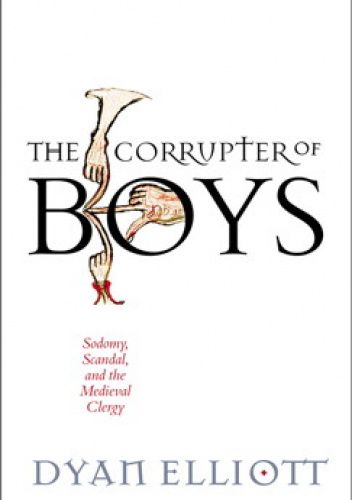
The Corrupter of Boys Sodomy, Scandal, and the Medieval Clergy
Dyan Elliott
The Corrupter of Boys Sodomy, Scandal, and the Medieval Clergy
Dyan Elliott
The Corrupter of Boys Sodomy, Scandal, and the Medieval Clergy Dyan Elliott 448 pages | 6 x 9 Cloth 2020 | ISBN 9780812252521 | $45.00s | Outside the Americas £36.00 Ebook editions are available from selected online vendors A volume in the Middle Ages Series View table of contents and excerpt "This is an exceptionally important and deeply disturbing book, which addresses the evidence of extensive, and largely tolerated, sexual predation involving young boys throughout the Middle Ages, and calls out the ongoing legacy of that practice, along with the arguments deployed by clerics to conceal it...Elliott deserves warm congratulations for what she has achieved. Her argument is intellectually convincing and ethically robust."—Medium Aevum "In my work as a court expert and consultant worldwide, I have been involved in more than one discussion with Church apologists who assert that the sexual violation of boys is a new phenomenon. Among the greatest failures of the hierarchical leadership of the Catholic Church has been the abysmal ignorance of the Church's own unrevised history, the unwillingness to entertain the validity of the events of the past when they are presented, and the inability to learn from that past. In The Corrupter of Boys Dyan Elliott shows us the evident parallels between the medieval and modern periods. It is a remarkable and invaluable book."—Thomas P. Doyle, J.C.D., C.A.D.C. "When the contemporary Catholic clergy sexual abuse crisis first broke in the 1980s, church officials in the United States and Rome pointed to the immorality of secular modernity as its cause. The Corrupter of Boys exposes once and for all the moral and intellectual emptiness of this claim. Elliott's deeply learned and unflinching account of the sexual privileges accorded priests and prelates from antiquity through the later middle ages—enshrined in theology and law and protected by secrets, silence, and lies—is an essential contribution towards a new history of Catholic sexuality. It is also a major step in the dismantling of the Catholic closet."—Robert A. Orsi, author of History and Presence "Dyan Elliott, an indefatigable medievalist-muckraker, argues that clerical child abuse is not just a modern issue. Here laid bare is the longue durée of an ecclesiastical culture anxious above all to preserve its power and reputation, rather than to confront its moral failings. Elliott's fearless take on the clergy's romance with pedophilia is certain to inspire both passionate controversy and exciting new research."—Barbara H. Rosenwein, Loyola University Chicago "Dyan Elliott's bold book is unflinching in its examination of the long history of clerical pederasty and the ecclesiastical culture of silence about sexual predators. Her argument will provoke important reconsiderations of the history of sexualities, of medieval anti-clericalism, and of conceptions of childhood."—Martha Newman, University of Texas at Austin In the fourth century, clerics began to distinguish themselves from members of the laity by virtue of their augmented claims to holiness. Because clerical celibacy was key to this distinction, religious authorities of all stripes—patristic authors, popes, theologians, canonists, monastic founders, and commentators—became progressively sensitive to sexual scandals that involved the clergy and developed sophisticated tactics for concealing or dispelling embarrassing lapses. According to Dyan Elliott, the fear of scandal dictated certain lines of action and inaction, the consequences of which are painfully apparent today. In The Corrupter of Boys, she demonstrates how, in conjunction with the requirement of clerical celibacy, scandal-averse policies at every conceivable level of the ecclesiastical hierarchy have enabled the widespread sexual abuse of boys and male adolescents within the Church. Elliott examines more than a millennium's worth of doctrine and practice to uncover the origins of a culture of secrecy and concealment of sin. She charts the continuities and changes, from late antiquity into the high Middle Ages, in the use of boys as sexual objects before focusing on four specific milieus in which boys and adolescents would have been especially at risk in the high and later Middle Ages: the monastery, the choir, the schools, and the episcopal court. The Corrupter of Boys is a work of stunning breadth and discomforting resonance, as Elliott concludes that the same clerical prerogatives and privileges that were formulated in late antiquity and the medieval era—and the same strategies to cover up the abuses they enable—remain very much in place.
Szczegóły
Rok wydania
2020
Liczba stron
448 str.
Wydawnictwo
University of Pennsylvania Press
Język
angielski
Format
papier
Gatunek
nauki społeczne (psychologia, socjologia, itd.)
ISBN
9780812252521
Dodaj „The Corrupter of Boys Sodomy, Scandal, and the Medieval Clergy" do swojej półki
Załóż darmowe konto i miej swoje lektury, oceny oraz postępy w jednym miejscu. Dołącz do 200+ czytelników, którzy już wiedzą, co przeczytali i co chcą przeczytać.


Trzy półki czytelnicze
Przeczytane, Teraz czytam i Chcę przeczytać — uporządkuj swoje lektury w sekundy.
Oceny i recenzje
Skala 1–10, prywatne notatki, ulubione cytaty. Wracaj do swoich opinii kiedy chcesz.
Statystyki i wyzwania
Ustal roczny cel czytelniczy i obserwuj jak rośnie liczba przeczytanych stron.
Rekomendacje i grafiki
Odkrywaj kolejne tytuły i generuj estetyczne podsumowania roku w książkach.
Rejestracja zajmuje mniej niż 30 sekund. Bez karty, bez zobowiązań.
Opinie czytelników
Oceń tę książkę
Oceniona książka automatycznie trafi na Twoją półkę Przeczytane.
Twoja ocena
Chcesz podzielić się ze światem tym, co czytasz?
Wygeneruj estetyczną grafikę z tej książki w kilka kliknięć, idealną jako post albo stories. Pełna kontrola nad motywem, tytułem i krótką notką. Gotowe do wrzucenia na Instagrama.