
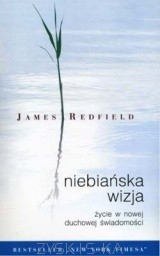
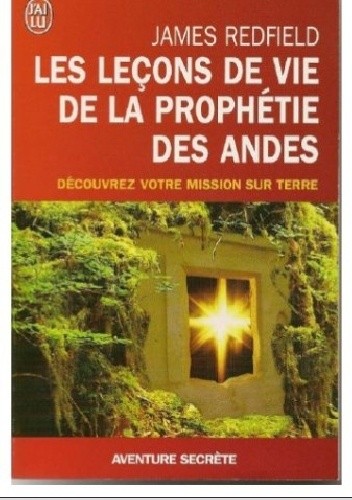
The Celestine Prophecy: An Adventure is a 1993 novel by James Redfield that discusses various psychological and spiritual ideas rooted in multiple ancient Eastern traditions and New Age spirituality. The main character undertakes a journey to find and understand a series of nine spiritual insights in an ancient manuscript in Peru. The book is a first-person narrative of the narrator's spiritual awakening as he goes through a transitional period of his life. Summary The book discusses various psychological and spiritual ideas that are rooted in many ancient Eastern traditions, such as how opening to new possibilities can help an individual establish a connection with the Divine. The main character undertakes a journey to find and understand a series of nine spiritual insights in an ancient manuscript in Peru. The book is a first-person narrative of spiritual awakening. The narrator is in a transitional period of his life and begins to notice instances of synchronicity, which is the belief that coincidences have a meaning personal to those who experience them. The story opens with the male narrator becoming reacquainted with an old female friend, who tells him about the insights contained in a manuscript dating to 600 BC, which has been only recently translated. After this encounter leaves him curious, he decides to go to Peru. On the airplane, he meets a historian who also happens to be interested in the manuscript. The historian explains how the world is currently undergoing an enormous shift in consciousness, elaborating on how things had been generally understood (until now) to be: 1) In the beginning, people believed the world to be governed by the forces of divinity; everything could be explained as an act of a god or gods, 2) With increasing knowledge of the world, brought about by scientific inquiry, people turned to the men and women of science for an explanation of life and their world, and 3) Since the problem of how to find meaning in the world could not be solved by science, people chose to instead focus on efforts to improve their lives materially, subduing and plundering the earth for its natural resources, with a hyper-emphasis on controlling economic conditions and market fluctuations. What was now occurring, explained the historian, was that the baseness of our current conditions had begun to infect our souls as well. We had become restless and desperate, primed for another fundamental shift in consciousness so as to bring about the creation of a new, better world. He also discovers that powerful figures within the Peruvian government and the Catholic Church are opposed to the dissemination of the material found in the manuscript. This is dramatically illustrated when the police try to arrest and then shoot the historian after his arrival. Threats to his life forced the narrator to live nomadically, moving from town to town in search of kind-hearted people who would offer lodging in exchange for more information about the manuscript and its message. While evading the Church and Peruvian government, the narrator finds time to read from the prized manuscript that offers 'Insights' as a sequence of passages. During pursuit, the narrator experiences real-world lessons that prepare him for each Insight in advance. In the end, he returns to the United States after learning the first nine Insights, and promises to reveal a 'Tenth Insight' to his audience in a short time. 'Insights' as such, are never made explicit to the reader, but are instead paraphrased through action; made into a sequence of parables that drive the storyline. Sourcing transcription is made impossible by the narrator, claiming, "it must be the way it is for sake of brevity"; adding that even a partial translation of the Ninth 'Insight' is a lengthy twenty pages, typewritten. In the novel, the Celestine Temple in the ruins of an ancient civilization in Peru was where the manuscript was buried. After it was found, the Incas re-habituated the abandoned cities. At some point, the ancients reached an "energy vibration level" threshold that allowed them to cross over into a reality of pure spirituality.
Szczegóły
- Data wydania
- 1 września 1995
- Liczba stron
- 246 str.
- Wydawnictwo
- Wrap Distribution Ltd.
- Język
- angielski
- Format
- papier
- Gatunek
- nauki społeczne (psychologia, socjologia, itd.)
- ISBN
- 9780446671002
Inne książki tych autorów
(10)


Opinie czytelników
Oceń tę książkę
Kiedy przeczytana?
Oceniona książka trafi na półkę Przeczytane.
Dodaj „The Celestine Prophecy" do swojej półki
Załóż darmowe konto i miej swoje lektury, oceny oraz postępy w jednym miejscu. Dołącz do grona zadowolonych czytelników, którzy już wiedzą, co przeczytali i co chcą przeczytać.
Trzy półki czytelnicze
Przeczytane, Teraz czytam i Chcę przeczytać. Uporządkuj swoje książki w sekundy.
Oceny i recenzje
Skala 1-10, prywatne notatki, ulubione cytaty. Wracaj do swoich opinii kiedy chcesz.
Statystyki i wyzwania
Ustal roczny cel czytelniczy i obserwuj jak rośnie liczba przeczytanych stron.
Rekomendacje i grafiki
Odkrywaj kolejne tytuły i generuj estetyczne podsumowania roku w książkach.