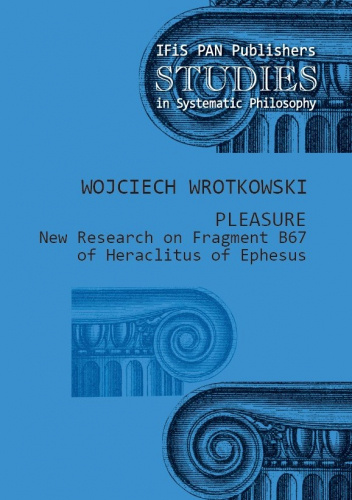
Pleasure. New Research on Fragment B67 of Heraclitus of Ephesus
Wojciech Wrotkowski
Pleasure. New Research on Fragment B67 of Heraclitus of Ephesus
Wojciech Wrotkowski
Opis There is much to indicate that the German scholars began a real, global revolution. I have become convinced that, apart from a very few exceptions, everyone in the last century, including world-renowned academics, put their trust in them. How is this possible? I am far from repeating the words: credo, quia absurdum, but it turns out that, up to the present, Diels’ and Kranz’s proposal has never been verified by anyone. This is clearly reflected as well in LSJ. It seems, then, that Zeller, Diels and Kranz aliique permulti bear full responsibility for – ut ita dicam – the “ambiguities” that have since accumulated and piled up, layer on layer, all around B67. I cannot connect ὀνομάζεται with < πῦρ > because of three clamant facts: (1) the absence of the relative pronoun ὅ between < πῦρ > and ὁκόταν (ut supra, passim); (2) the audacious attempt to give the phrase καθ' ἡδονήν a sense that it never possessed; (3) the context in which fragment B67 was quoted. These are, in my opinion, real impediments to the road chosen by Zeller, Diels, Kranz, Kirk, Marcovich, Conche and countless others. I cannot circumvent them or pass them by in silence. Why was this so difficult for me, while for others it was so easy…? Yes, I understood that, in order to somehow justify associating ὀνομάζεται with < πῦρ >, one must: (1) insert < ὅ > between < πῦρ > and ὁκόταν, and then (2) fit the word ἡδονή to < πῦρ >. But at the same time I realised that, unfortunately, the matter is not so simple, especially when one seeks at all cost to give the rather uncertain, and not the only, conjecture < πῦρ > some kind of name – whatever name, in fact – not according to someone’s pleasure, but according to the scent of those roots with which πῦρ was supposed to be mixed during sacrificial offerings. The whole enterprise is really perilous when we consider that for fire mixed with roots we have no name whatsoever attested by tradition, and that the context in which Hippolytus quoted B67 in no way indicates either the making of sacrifices or the smells associated therewith. Wojciech Wrotkowski, Pleasure. New Research on Fragment B67 of Heraclitus of Ephesus, pp. 143-145. Książka do kupienia tu: https://ifispan.pl/shop/pleasure-new-research-on-fragment-b67-of-heraclitus-of-ephesus-wojciech-wrotkowski/ "Introduction" i "Appendix" na profilu autora: https://pan-pl.academia.edu/WojciechWrotkowski
Szczegóły
Rok wydania
2023
Liczba stron
250 str.
Wydawnictwo
Wydawnictwo IFiS PAN
Język
angielski
Format
papier
Cykl
Studia z filozofii systematycznej
Gatunek
filozofia, etyka
ISBN
9788376832012
Dodaj „Pleasure. New Research on Fragment B67 of Heraclitus of Ephesus" do swojej półki
Załóż darmowe konto i miej swoje lektury, oceny oraz postępy w jednym miejscu. Dołącz do 200+ czytelników, którzy już wiedzą, co przeczytali i co chcą przeczytać.

Trzy półki czytelnicze
Przeczytane, Teraz czytam i Chcę przeczytać — uporządkuj swoje lektury w sekundy.
Oceny i recenzje
Skala 1–10, prywatne notatki, ulubione cytaty. Wracaj do swoich opinii kiedy chcesz.
Statystyki i wyzwania
Ustal roczny cel czytelniczy i obserwuj jak rośnie liczba przeczytanych stron.
Rekomendacje i grafiki
Odkrywaj kolejne tytuły i generuj estetyczne podsumowania roku w książkach.
Rejestracja zajmuje mniej niż 30 sekund. Bez karty, bez zobowiązań.
Opinie czytelników
Oceń tę książkę
Oceniona książka automatycznie trafi na Twoją półkę Przeczytane.
Twoja ocena
Chcesz podzielić się ze światem tym, co czytasz?
Wygeneruj estetyczną grafikę z tej książki w kilka kliknięć, idealną jako post albo stories. Pełna kontrola nad motywem, tytułem i krótką notką. Gotowe do wrzucenia na Instagrama.