
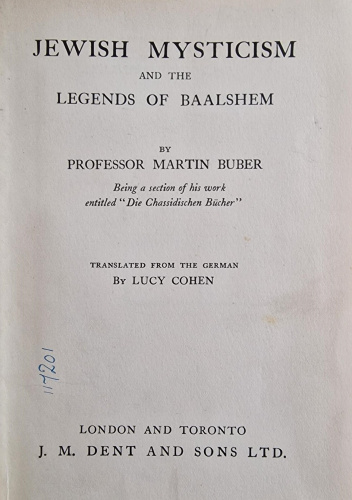
Jewish Mysticism and the Legends of Baalshem
Martin Buber
Jewish Mysticism and the Legends of Baalshem
Martin Buber
A few months ago I was given a book dealing with the Jewish sect, the Chassids. The sect owed its origin to a reaction against the orthodox Judaism prevailing in the eighteenth century in Poland—a time of many other revivalist movements. The book much struck me. It seemed to me that the ideals of the Chassids present somewhat new and different religious conceptions from those usually attributed to Judaism, and the quaint form in which they are conveyed through legends and allegories appeared to me sufficiently striking to interest the general reader and therefore to be worth translating. The author, Professor Buber, lived for six years among the Chassids, and collected from their own lips these stories and the descriptions of their beliefs, just as they had been handed down to them, mostly verbally, for generations, and I only try to transmit his words. The Chassids, living in remote towns and villages in the south-east of Poland, Rumania, and the Ukraine, were despised for their ignorance by their more learned brethren in other parts of Poland; for they were a primitive and simple people, and their beliefs were mixed with superstition. But they were for the most part a devout people, and their doctrine, often mystic in character and form, inculcates much humility, charity, and love. They were and they remain, in One sense, completely orthodox. The believed in the divinity of the Law and observed all its enactments minutely, but their religion was not exhausted in their fulfilment of the Law; a less rigid and more emotional element entered into their religious observances. The founder of Chassidism, Baalshem (the Rabbi Israel ben Eliezer, Baalshem, Master of the Wonderful Name of God),lived from 1700 to 1760. He started as a boy as a beadle of the prayer-house in his little village, and studied the Law (the Torah),but always in secret. Later he settled in Brody as a teacher of small children, and he was recognized as an arbiter in disputes. He married the sister of a scholar, but hid his own learning from him. To his wife he, however, revealed it, and she insisted on accompanying him on his wanderings in the Carpathians where they lived in great privation for seven years. He worked with his own hands for their support, yet devoutly performed all the religious rites incumbent upon pious Jew. But in addition he would often go away in solitude to the mountain-tops and pray there in rapture and ecstasy. After some years he settled in Mesbiz and taught in Podolia and Wolynia. Finally he came to be regarded as a saint and miracle-worker.
Szczegóły
Rok wydania
1931
Liczba stron
230 str.
Wydawnictwo
J. M. Dent & Sons Ltd
Język
angielski
Format
papier
Gatunek
religia
Inne książki autora
Opinie czytelników
Oceń tę książkę
Oceniona książka trafi na półkę Przeczytane.
Dodaj „Jewish Mysticism and the Legends of Baalshem" do swojej półki
Załóż darmowe konto i miej swoje lektury, oceny oraz postępy w jednym miejscu. Dołącz do grona zadowolonych czytelników, którzy już wiedzą, co przeczytali i co chcą przeczytać.



Trzy półki czytelnicze
Przeczytane, Teraz czytam i Chcę przeczytać. Uporządkuj swoje książki w sekundy.
Oceny i recenzje
Skala 1-10, prywatne notatki, ulubione cytaty. Wracaj do swoich opinii kiedy chcesz.
Statystyki i wyzwania
Ustal roczny cel czytelniczy i obserwuj jak rośnie liczba przeczytanych stron.
Rekomendacje i grafiki
Odkrywaj kolejne tytuły i generuj estetyczne podsumowania roku w książkach.